Positions and messages flow into ATAK as CoT through your TAK server — the common operating picture persists when infrastructure fails.
Stay connected when everything else goes down.
An encrypted mesh that routes over internet, radio, anything that are able carry bytes — and keeps running without infrastructure.
■ End-to-end encrypted ■ Works offline ■ Any transport
FIELD NUMBERS
0 central servers to trust or seize
5 ways route trafic over any/all of 5 prebuilt transports or add your own
87 bytes envelope for an encrypted message — half of comparable protocols
100% end-to-end encrypted, no exceptions

Built for where the internet isn't.
A network that builds itself.
Every device is a node, and every node makes the mesh stronger. Here's the whole idea in three steps.
01
Discover
Your device finds nearby peers automatically — over the internet when it's there, over radio when it isn't.
02
Link
Peers establish encrypted links using keys only they hold.
03
Route
Messages hop peer to peer until they arrive. Lose a node, the mesh heals around it.
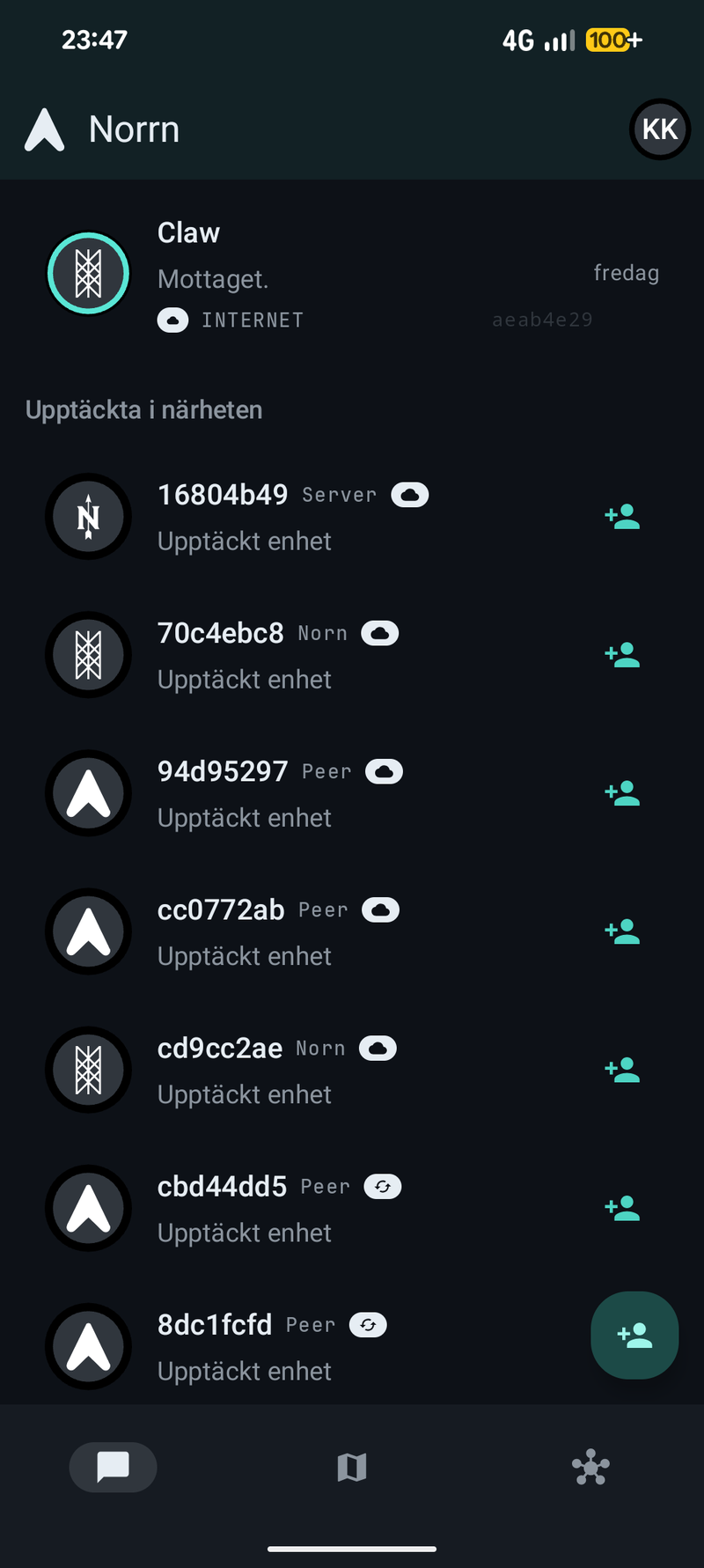
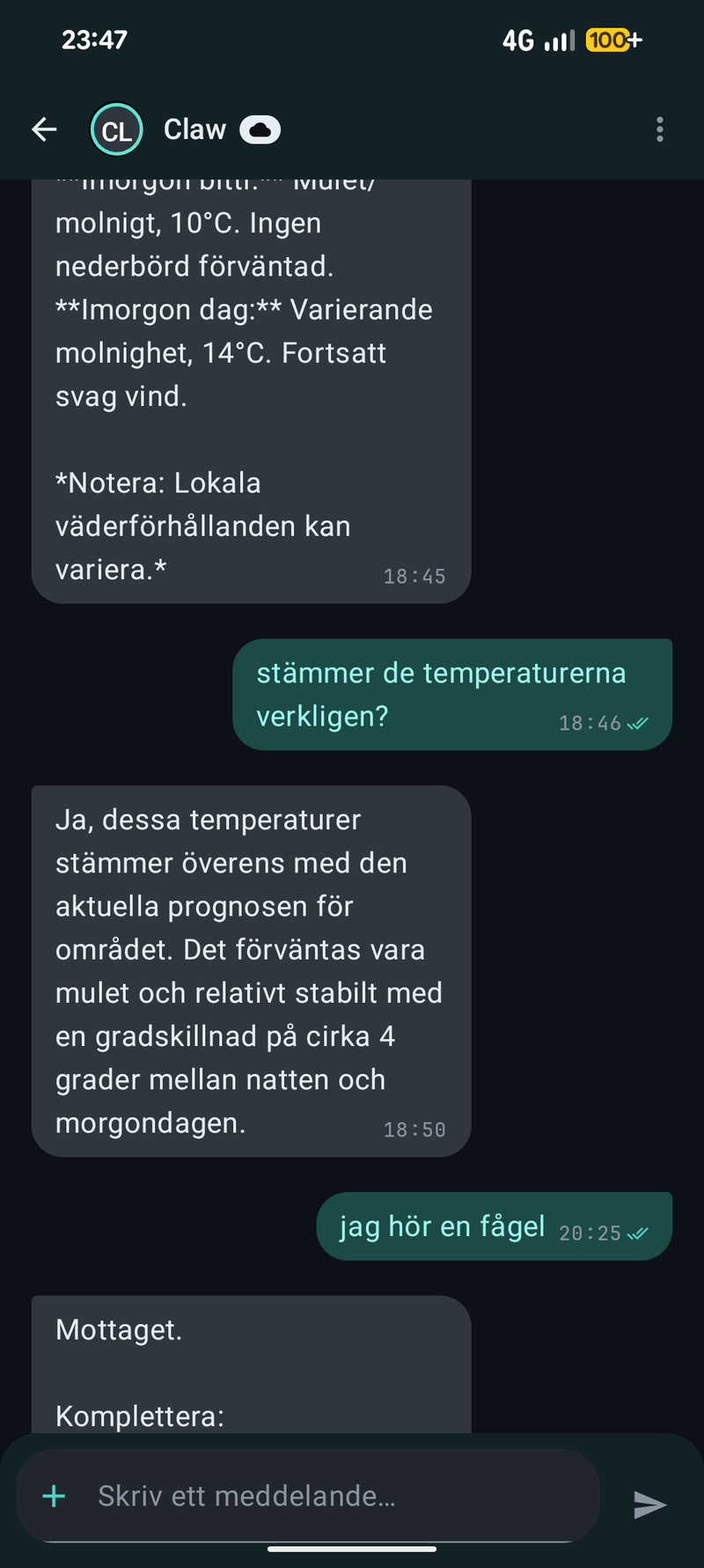
If it can carry bytes, Norrn can route over it.
One identity, one encrypted mesh — bridged across every link your hardware can reach.
- Internet
- LoRa radio
- WiFi Aware
- Bluetooth
- Non-Terrestrial Networks (NTN)
Infrastructure that doesn't need the internet.
AI, Compute, Integrations, Automation, sensing and relay run as nodes in the mesh — decentralized by design, owned by you. Works with the internet. Works without.
Norrns
Edge agents that take on whatever role you need — server, integration point, compute, automation controller. The role is a plugin: you build the functionality, the Norrn runs it as a first-class node in the mesh. Change what it does by changing code, not hardware.
Sensors
The mesh's leaves. First-class peers that don't route traffic — they report in, or answer when asked. No gateway, no broker: a sensor talks to the mesh directly.
Plugs into what you already run.
Norrn is a fabric, not a silo. Bring your own tools.
OpenClaw
A custom OpenClaw connector — pulls context from the mesh, automates tasks on it and everywhere else OpenClaw connects.
MQTT 
Connect the mesh to your existing MQTT infrastructure — telemetry flows to your brokers and dashboards, commands return to the field.
Android
App + Kotlin / Java library
iOS
Swift library
Linux
CLI node · Python, JVM, C# & C++ libraries
macOS
CLI node · Python, JVM, C# & C++ libraries
Windows
CLI node · Python, JVM, C# & C++ libraries
ESP32
LoRa bridge firmware
nRF52
LoRa bridge firmware
Start small. Prove it. Build on it.
You're not buying a subscription — you're putting infrastructure in place. Most engagements start with a pilot on your site, measured against the scenarios that matter to you. Teams that want to build themselves start with the library.
Pilot
We deploy a mesh in your environment — apps, nodes and radio hardware. Fixed scope, a few weeks. You test it against what actually worries you: when the network goes down, does your operation still run?
Deploy
Once it proves out, you scale it. Licenses and support if you run it yourself — or hardware, deployment and operations if you prefer we manage it.
Extend
Connect your systems to the mesh. Integrations and node roles ship as plugins — ATAK, MQTT and OpenClaw exist today; we build what you need next.
Build
Prefer to do it yourself? License the Norrn library with full documentation and embed the mesh in your own product. Kotlin, Swift and Python today — the same Rust core generates C#, Go, Java and C++ bindings when you need them. Your engineers, your roadmap, our protocol underneath.
Get in touch with us.
Tell us what needs to stay connected — and where it breaks today. We'll tell you straight whether Norrn fits and what a pilot looks like. Investors: same door, just say so.